Do Ac1 Levels and Blood Sugar Reads Correlation
On this page:
- What is the A1C test?
- Why should a person go the A1C test?
- How is the A1C test used to diagnose type 2 diabetes and prediabetes?
- Is the A1C test used during pregnancy?
- Tin can other blood glucose tests be used to diagnose blazon ii diabetes and prediabetes?
- Tin the A1C examination outcome in a unlike diagnosis than the blood glucose tests?
- Why do diabetes blood examination results vary?
- How precise is the A1C test?
- How is the A1C test used after diagnosis of diabetes?
- What A1C goal should I have?
- How does A1C relate to estimated average glucose?
- Will the A1C test show short-term changes in blood glucose levels?
- Clinical Trials for the A1C Test and Diabetes
What is the A1C test?
The A1C test is a blood test that provides information about your boilerplate levels of blood glucose, besides called blood sugar, over the past three months. The A1C examination can be used to diagnose blazon 2 diabetes and prediabetes.1 The A1C exam is also the primary examination used for diabetes management.
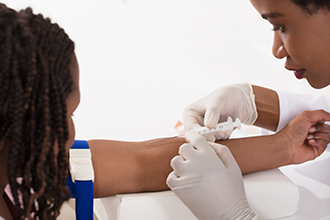
The A1C test is sometimes chosen the hemoglobin A1C, HbA1c, glycated hemoglobin, or glycohemoglobin test. Hemoglobin is the part of a reddish blood cell that carries oxygen to the cells. Glucose attaches to or binds with hemoglobin in your blood cells, and the A1C test is based on this attachment of glucose to hemoglobin.
The college the glucose level in your bloodstream, the more glucose volition attach to the hemoglobin. The A1C exam measures the amount of hemoglobin with attached glucose and reflects your average claret glucose levels over the past 3 months.
The A1C test result is reported as a percentage. The college the percentage, the college your blood glucose levels have been. A normal A1C level is beneath 5.7 pct.
Why should a person get the A1C examination?
Testing can assistance wellness care professionals
- notice prediabetes and counsel you lot about lifestyle changes to help you lot delay or forbid type 2 diabetes
- detect type 2 diabetes
- work with you to monitor the disease and help make treatment decisions to forbid complications
If you have risk factors for prediabetes or diabetes, talk with your dr. near whether you lot should be tested.

How is the A1C test used to diagnose blazon 2 diabetes and prediabetes?
Health care professionals can use the A1C test solitary or in combination with other diabetes tests to diagnose type 2 diabetes and prediabetes. You don't have to fast before having your claret fatigued for an A1C test, which means that blood tin be drawn for the examination at whatsoever time of the solar day.
If you don't have symptoms but the A1C test shows yous have diabetes or prediabetes, you should have a echo test on a dissimilar day using the A1C examination or one of the other diabetes tests to confirm the diagnosis.2
A1C results and what the numbers mean
| Diagnosis* | A1C Level |
|---|---|
| Normal | below 5.7 pct |
| Prediabetes | 5.7 to 6.4 percentage |
| Diabetes | half dozen.5 percent or above |
When using the A1C exam for diagnosis, your dr. will ship your blood sample taken from a vein to a lab that uses an NGSP-certified method. The NGSP, formerly chosen the National Glycohemoglobin Standardization Program, certifies that makers of A1C tests provide results that are consistent and comparable with those used in the Diabetes Control and Complications Trial.
Blood samples analyzed in a doctor's office or clinic, known as betoken-of-care tests, should not be used for diagnosis.
The A1C test should not be used to diagnose type 1 diabetes, gestational diabetes, or cystic fibrosis-related diabetes. The A1C exam may give false results in people with certain conditions.
Having prediabetes is a run a risk factor for developing type 2 diabetes. Within the prediabetes A1C range of 5.vii to 6.4 percent, the higher the A1C, the greater the gamble of diabetes.
Is the A1C test used during pregnancy?
Health care professionals may employ the A1C test early in pregnancy to see if a woman with run a risk factors had undiagnosed diabetes before becoming pregnant. Since the A1C exam reflects your average blood glucose levels over the by 3 months, testing early on in pregnancy may include values reflecting time earlier you were significant. The glucose challenge examination or the oral glucose tolerance test (OGTT) are used to check for gestational diabetes, usually between 24 and 28 weeks of pregnancy. If yous had gestational diabetes, you should exist tested for diabetes no afterward than 12 weeks later your babe is born. If your blood glucose is still loftier, y'all may have blazon 2 diabetes. Fifty-fifty if your blood glucose is normal, you still take a greater run a risk of developing type 2 diabetes in the future and should get tested every 3 years.
Can other blood glucose tests be used to diagnose type two diabetes and prediabetes?
Yes. Wellness care professionals besides utilise the fasting plasma glucose (FPG) test and the OGTT to diagnose type ii diabetes and prediabetes. For these blood glucose tests used to diagnose diabetes, you must fast at least 8 hours earlier you lot have your blood fatigued. If you have symptoms of diabetes, your doctor may use the random plasma glucose test, which doesn't require fasting. In some cases, health care professionals use the A1C test to assistance ostend the results of another blood glucose test.
Tin the A1C exam result in a different diagnosis than the blood glucose tests?
Yes. In some people, a blood glucose examination may show diabetes when an A1C examination does not. The opposite can also occur—an A1C test may indicate diabetes even though a claret glucose examination does not. Because of these differences in test results, health care professionals echo tests before making a diagnosis.
People with differing examination results may exist in an early stage of the disease, when claret glucose levels have not risen loftier enough to show up on every test. In this case, wellness care professionals may choose to follow the person closely and repeat the test in several months.
Why do diabetes blood examination results vary?
Lab test results tin vary from day to mean solar day and from test to test. This tin can be a effect of the following factors:
Blood glucose levels move up and down
Your results can vary considering of natural changes in your blood glucose level. For example, your blood glucose level moves upwards and down when you eat or exercise. Sickness and stress also tin can touch your claret glucose test results. A1C tests are less likely to exist affected past short-term changes than FPG or OGTT tests.
The following chart shows how multiple blood glucose measurements over 4 days compare with an A1C measurement.
Blood Glucose Measurements Compared with A1C Measurements over iv Days
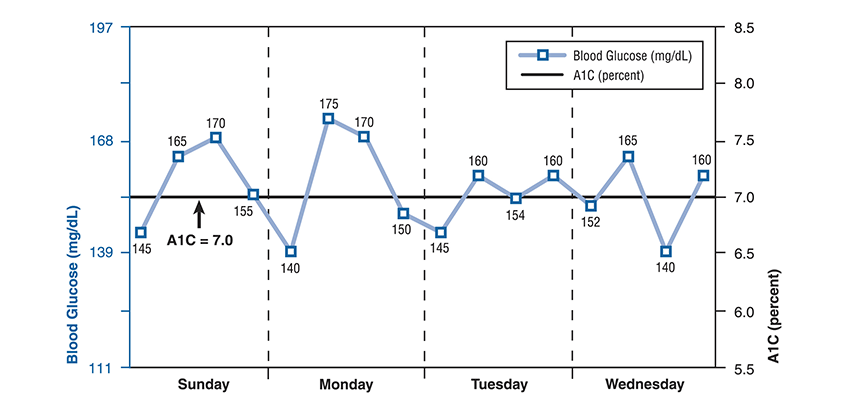
The straight blackness line shows an A1C measurement of 7.0 pct. The blue line shows an example of how blood glucose test results might look from self-monitoring four times a 24-hour interval over a 4-twenty-four hour period period.
A1C tests can be affected past changes in red blood cells or hemoglobin
Atmospheric condition that modify the life bridge of carmine claret cells, such every bit contempo blood loss, sickle cell disease, erythropoietin handling, hemodialysis, or transfusion, can change A1C levels.
A falsely high A1C result tin occur in people who are very low in atomic number 26; for instance, those with iron-deficiency anemia. Other causes of faux A1C results include kidney failure or liver disease.
If you're of African, Mediterranean, or Southeast Asian descent or have family members with sickle cell anemia or a thalassemia, an A1C examination can exist unreliable for diagnosing or monitoring diabetes and prediabetes. People in these groups may take a different type of hemoglobin, known as a hemoglobin variant, which can interfere with some A1C tests. Nigh people with a hemoglobin variant have no symptoms and may not know that they carry this type of hemoglobin. Health care professionals may suspect interference—a falsely loftier or depression result—when your A1C and blood glucose examination results don't match.

Not all A1C tests are unreliable for people with a hemoglobin variant. People with false results from one type of A1C exam may need a different type of A1C test to measure their average claret glucose level. The NGSP provides data for health care professionals about which A1C tests are appropriate to use for specific hemoglobin variants.
Read nigh diabetes blood tests for people of African, Mediterranean, or Southeast Asian descent. The NIDDK has information for health care providers on Sickle Cell Trait & Other Hemoglobinopathies & Diabetes.
Small changes in temperature, equipment, or sample handling
Even when the same blood sample is repeatedly measured in the same lab, the results may vary because of small changes in temperature, equipment, or sample handling. These factors tend to affect glucose measurements—fasting and OGTT—more than than the A1C test.

Wellness care professionals understand these variations and repeat lab tests for confirmation. Diabetes develops over time, so even with variations in test results, health intendance professionals tin tell when overall blood glucose levels are becoming too high.
How precise is the A1C test?
When repeated, the A1C test result can be slightly higher or lower than the first measurement. This means, for example, an A1C reported as 6.8 pct on one test could be reported in a range from 6.four to 7.2 percentage on a repeat test from the aforementioned blood sample.3 In the past, this range was larger but new, stricter quality-control standards mean more precise A1C test results.
Wellness intendance professionals can visit world wide web.ngsp.org to find information nigh the precision of the A1C test used by their lab.
How is the A1C exam used later on diagnosis of diabetes?
Your health care professional may use the A1C examination to set up your treatment goals, modify therapy, and monitor your diabetes management.
Experts recommend that people with diabetes have an A1C examination at least twice a year.4 Wellness care professionals may check your A1C more oft if you aren't coming together your treatment goals.4
What A1C goal should I have?
People will have unlike A1C targets, depending on their diabetes history and their general health. You should discuss your A1C target with your health care professional. Studies take shown that some people with diabetes tin reduce the chance of diabetes complications by keeping A1C levels below vii percent.
Managing blood glucose early on in the course of diabetes may provide benefits for many years to come. However, an A1C level that is prophylactic for one person may not be safe for another. For case, keeping an A1C level beneath 7 pct may not be rubber if information technology leads to issues with hypoglycemia, besides called low blood glucose.
Less strict blood glucose control, or an A1C between vii and eight pct—or even higher in some circumstances—may be appropriate in people who have
- limited life expectancy
- long-standing diabetes and trouble reaching a lower goal
- astringent hypoglycemia or disability to sense hypoglycemia (besides called hypoglycemia unawareness)
- avant-garde diabetes complications such as chronic kidney disease, nerve problems, or cardiovascular disease
How does A1C chronicle to estimated average glucose?
Estimated average glucose (eAG) is calculated from your A1C. Some laboratories report eAG with A1C exam results. The eAG number helps y'all relate your A1C to daily glucose monitoring levels. The eAG calculation converts the A1C per centum to the aforementioned units used past home glucose meters—milligrams per deciliter (mg/dL).
The eAG number volition not match daily glucose readings because information technology'due south a long-term average—rather than your blood glucose level at a single fourth dimension, every bit is measured with a home glucose meter.
Will the A1C test show short-term changes in blood glucose levels?
Large changes in your blood glucose levels over the past calendar month will show up in your A1C exam outcome, but the A1C test doesn't show sudden, temporary increases or decreases in blood glucose levels. Even though A1C results represent a long-term average, claret glucose levels within the past 30 days have a greater effect on the A1C reading than those in previous months.
Clinical Trials for the A1C Examination and Diabetes
The National Constitute of Diabetes and Digestive and Kidney Diseases (NIDDK) and other components of the National Institutes of Health (NIH) carry and back up research into many diseases and weather.
What are clinical trials and are they right for you?
Clinical trials are part of clinical research and at the heart of all medical advances. Clinical trials expect at new ways to foreclose, detect, or treat affliction. Scientists are conducting inquiry to acquire more almost diabetes, including studies about A1C. For instance
- how the relationship between A1C and blood glucose may vary in different racial and ethnic groups
- to find other tests that may be better than A1C for some people
- to look for ways to further improve A1C examination results. Because the A1C value depends on the average life span of your red blood cells, knowing whether the life bridge of your red blood cells is longer or shorter may give your doctor helpful information.
Researchers likewise use clinical trials to look at other aspects of care, such as improving the quality of life for people with chronic illnesses. Find out if clinical trials are right for you.
What clinical trials are open?
Clinical trials that are currently open and are recruiting can be viewed at www.ClinicalTrials.gov.
References
Source: https://www.niddk.nih.gov/health-information/diagnostic-tests/a1c-test

Postar um comentário for "Do Ac1 Levels and Blood Sugar Reads Correlation"