How to Make Art on Map Blend in Photoshop
Add Realistic Artwork to a Wrinkled Surface with Photoshop'south Displacement Map
Photoshop offers Warp, which allows you lot to bend artwork. Warp is neat for cylindrical mapping, or angle fine art in a flag-like wave. The Liquify filter allows yous to push pixels effectually as if you were working with wet finger paint. But to place artwork realistically on an irregular surface, yous need Displacement Maps.
Deportation mapping requires two players: The epitome you wish to warp (whose pixels you wish to displace), and the paradigm to be used as a map (the displacement map). Commonly, maps are grayscale images.
In this exercise, nosotros need to "impress" a logo on a sweatshirt and so that information technology falls realistically down in the folds of the cloth.
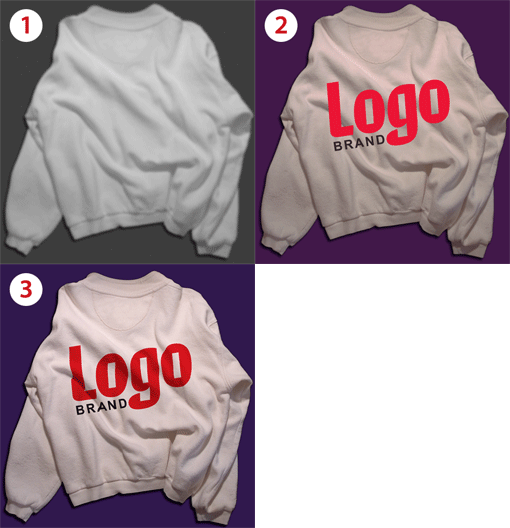
1. To create the map, duplicate the image: Image > Indistinguishable. Name the epitome ShirtMap (Effigy 1).
Figure i: Duplicate the image to brainstorm creating a Displacement Map.

2. Catechumen the prototype to grayscale: Paradigm > Fashion > Grayscale.
3. If there'south a lot of little granular particular, the mapped artwork will go into every little nook and cranny. Y'all just want the artwork to follow the general shape of the cloth, not every trivial tiny nub. And then blur the epitome to smooth out texture, merely go on the "bends." Choose Filter > Mistiness > Gaussian Mistiness. Experiment with the sliders until the surface is shine, but you nevertheless have the light-and-dark of the fabric's folds (Figure two).
Effigy 2: Blurring the grayscale map enables the artwork to follow the large folds of the material smoothly, without being roughened by the texture of the fabric itself.

4. Save the map image as a PSD or TIFF. You tin shut information technology or leave it open?—?it doesn't affair. Merely the image must be saved to deejay and then Photoshop can place it when you demand to use information technology as a map.
five. Return to your original colour epitome by clicking on its championship bar.
vi. Identify the artwork onto the shirt. Y'all can copy and paste from some other epitome, or use File > Identify to bring in either vector fine art or another paradigm. Use the handles of placed art to scale and rotate every bit necessary. When yous're finished positioning and manipulating the artwork, click the checkmark in the Options bar at the top of the interface, or press the Enter/Return cardinal on your keyboard (Figure iii).
Figure iii: Artwork positioned, and set up to be distorted past the Displacement Map.

7. If you lot use File > Identify for vector artwork, the artwork volition automatically be converted to a Smart Object. While vector Smart Objects offer the reward of being endlessly scalable with no loss of item, they won't allow themselves to play with Displacement Maps. (Note that raster Smart Objects are discipline to loss of particular when scaling, since they are pixel-based.)
To convert the Smart Object to pixels so you can distort the logo, make sure you are satisfied with the size and angle of the artwork, and and then choose Layer > Rasterize > Smart Object.
8. Now information technology's time to use the Displacement Map. Choose Filter > Distort > Displace. In the Displace dialogo box (Figure 4), accept the default options and click OK.
Figure 4: The default Displacement settings are usually satisfactory, so just click OK.

Photoshop then asks which image you lot want to utilize as the Displacement map. Navigate to the map prototype you created, and select it (Figure 5).
Figure 5: Choose the map prototype you created earlier.

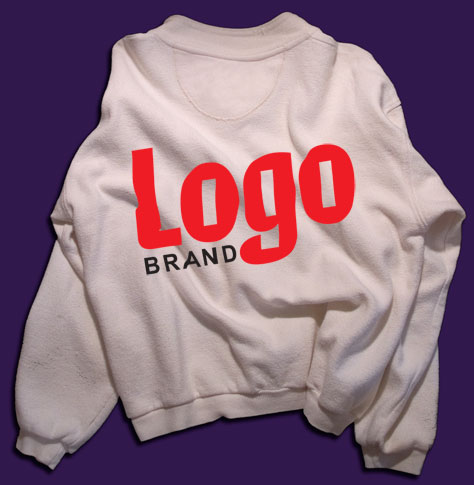
ix. The artwork is "bent" nicely, but still looks fake. You need to let the shading of the shirt evidence through the logo artwork. To do this, change the blending way of the logo artwork layer to Multiply (Figure six).
Figure vi: the artwork seems to be floating to a higher place the shirt (immediately below). Change the blending mode of the artwork layer to Multiply, and then the shading of the underlying image shows through the logo artwork (below center). The Blending Manner control is at the top of the Layers palette (bottom).


x. For even more fun, yous tin can make the logo artwork act every bit a mask for layers above, past creating a Clipping Grouping. Fifty-fifty though nosotros tend to think of masks as needing to be above the content they mask, Clipping Groups work from underneath.
To a higher place the logo art layer, create another layer containing artwork. You can copy and paste, or use File > Place to bring in raster or vector fine art (Figure seven). You lot won't need to rasterize a Smart Object for this trick to piece of work, though.
Effigy 7: In a layer above the distorted logo, place artwork to be masked past the shape of the logo fine art.

Once the top layer is in place, hover over the dividing line between the log art layer and the new layer to a higher place it. Hold down Alt (Windows) or Option (Macintosh), and when y'all see the strange picayune icon made of two interlocking circles and an arrow, click on the dividing line.
Figure eight: Creating a Clipping Group. Hover between the layers, hold down the Alt (PC) or Pick (Mac) central, and then click (immediately below). The thumbnail for the top layer is indented, and at present sports a downward-pointing pointer indicating that it's masked by the contents of the next layer down. The masked layer also inherits the blending mode of the bottom layer of the group (lesser image).


This how-to originally appeared on Practicalia.net.
Source: https://creativepro.com/add-realistic-artwork-wrinkled-surface-photoshops-displacement-map/

Postar um comentário for "How to Make Art on Map Blend in Photoshop"